Traversing the library of Babel
On 1941, Jorge Luis Borges published the fictional short story “The Library of Babel” (La biblioteca de Babel)
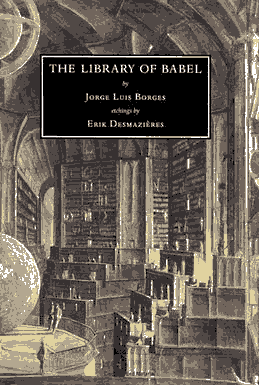
a library with all the possible books, including those written in the future, waiting to be discovered.
The problem for its users us that it is impossible to separate meaning from nonsense. The book describes people leaning on religion and other beliefs to decide what is useful or isn’t.
The short story premise is analogous of the Infinite Monkey Theorem: any random generation of text with enough time will eventually lead to any finished work.
The old and the new way
For the library to be useful, readers would need to search the book that they are looking for one character at a time.
Most people think of this as writing, a skill that requires understanding of the topic, learning the language of writing and a shared interest with the reader.
But some time around 2020, transformer technology and other advances have made prompts a viable alternative to traverse the library.
Here is how it works: A machine takes a lot of energy to store a set of information of what is meaningful or isn’t. Then a conversation structure with the human emerges. The human prompts something, and the machine produces the likely continuation of that prompt.
Prompts can be requests of any kind or level of abstraction, and the machine answer can produce anything that combines any of the inputs in any way, coherent or not, trutful or not, useful or not.
LLMs do offer a way to traverse the library in a different way that in theory requires less effort compared to writing. A single prompt produces the most likely answer, and then subsequent prompts refine the generated output.
But there is a limit of precision and truthfulness that cannot be overcomed. They are random necessarily as they are statistical machines. And eventually the prompts are too long and the quality of the response starts to degrade. It cannot fully converge into a book or any other complicated form.
Who goes to the library today?
When Borges wrote his essay, libraries had a different role to today. Neither internet nor computers were invented yet. Most people access to culture relied on the library. Newspapers were there, radio was a baby and that’s about it.
Today’s libraries are less common. There are internet equivalent structures and most books, essays, papers, articles and any other form are available in there, which makes internet a new form of library.
Thinking on how to access to culture alone is too narrow for the nowadays equivalent of the library. Internet provides a lot of entertainment, work, close peer communication needs and community access.
I would argue than in the old world of seeking for information in the library, using LLMs would not make sense. Getting incorrect information knowingly would have no use.
But the LLM itself makes information access much easier, almost instantaneous. Which transforms the user of the library by inducing demand.
Propaganda, advertisement and entertainment are good candidates for its use. Suddenly, creating plausible but unverified content is very cheap and frictionless, so these modes of communication are more available. Flooding the zone.
The case for traversing programs
Programming has also been subject to this new way to traverse the universe of possible programs. In theory LLMs allow to create prototypes much faster. Programming also has self evaluating error correction mechanisms, like interpreters, verifiers, type checkers or tests that reduce the sloppiness of the final result.
But my personal experience is that the generated code is monotonous and lacks intent, which I described in the previous blog post as “LLM monotony”. [[2026-01-20-20260120223336-llm-monotony]]
It seems like over time this lack of intent or theory builds up and creates what Margaret Storey describes as Cognitive Debt, which is the careless sibling of technical debt. Eventually the cognitive debt reaches a limit of what is understood, so even the LLM lacks the understanding to manipulate it further.
To me, from a software design angle, it seems inevitable. The goal of software is to produce a executable version of the theory of the company goals, so adding more code that is not understood is a liability.
The solutions to this problem are well known. Meeting each other and share the theory building.