Exodata
Borrowing from the concept of exosomatic memory and exosomatic energy, I was wondering if it makes sense to use the term exosomatic data or simply exodata for the data stored about us that is stored and processed outside our control.
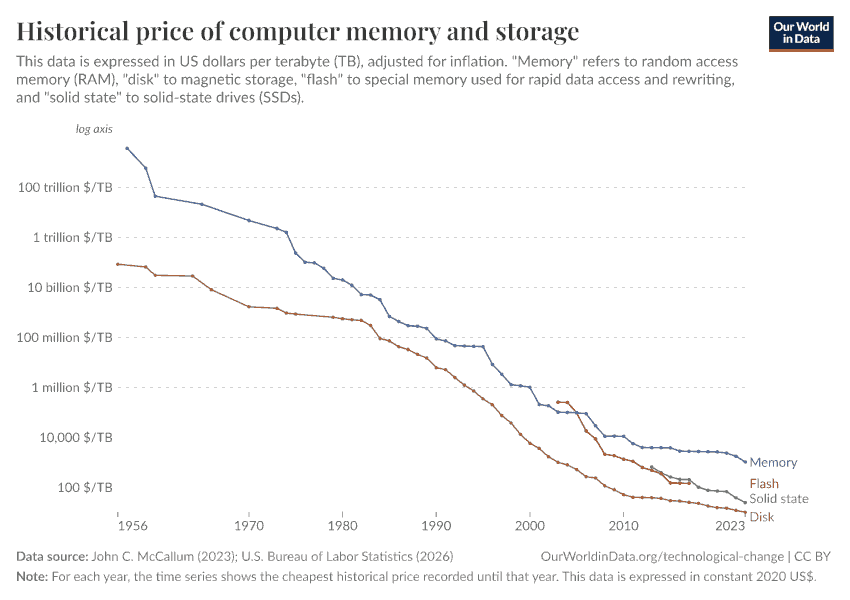
The motivation for exodata to exist is relatively simple: given how cheap storage and processing are, there is a business incentive to store and process this data. If companies use this data for profiling and selling humans (human futures), then the analysis would be closer to surveillance capitalism.
The personal experience of exodata
Today I want to focus on the consumer side of things. Storage is very cheap but local software did not grow as quickly. So while it is easy to get 1 million pictures in a hard drive, it isn’t that easy to make a meaningful, contextually rich, curated collection out of it.
Instead, the same companies that want to monetise the data offer to manage it for us, including most of the machine learning necessary for classification at the volume needed. They also offer to make it safe and manage multi site replication. This service may not be free and require a second rent payment.
Given the temptation, most people stopped caring about managing their data at that level, nor have a good backup policy. They surrendered the memory formation in exchange for the ability to store everything. No memories, just data.
I am suggesting that these giants amount of data are hoarded but have little use for the person, while they have massive value for the companies.
I have seen this pattern first hand: people reach their google or apple storage limit, so they have the choice of either deleting or buying more storage. At the time of writing, google charges £16 for 100gb per year.
There are 3 risks to increasing the storage:
- The next upgrade is a few years away
- Access to your data can be restricted for no reason
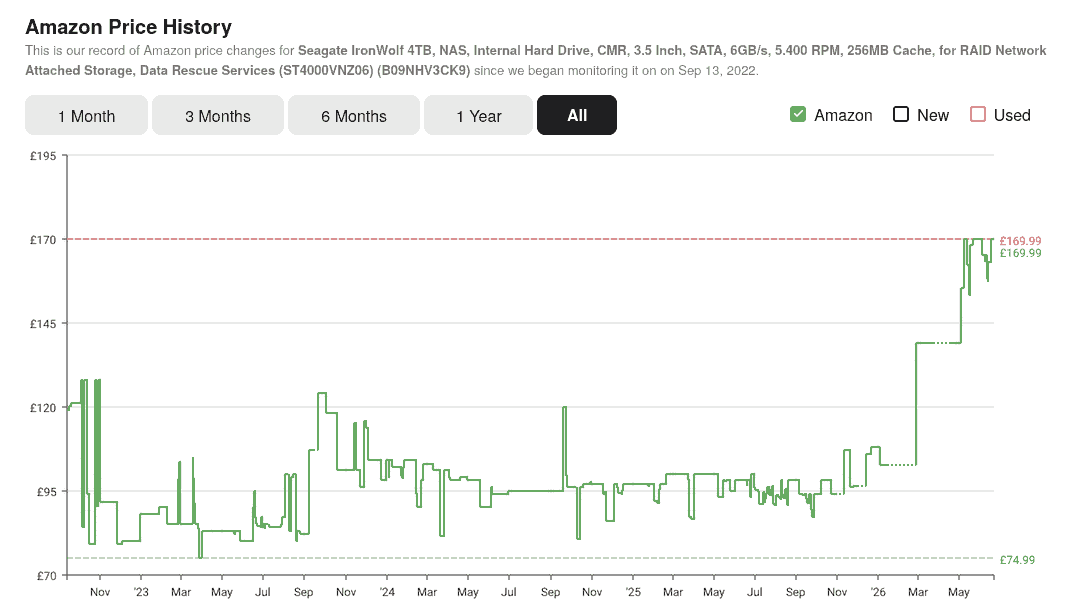
- The 2026 trends in price suggest that price will go up short term
Memory formation
Personally I chose to reject to have my data elsewhere a few years ago. While the storage is much cheaper I have to think on the backup and perform the memory formation. This consumes time that is proportional to the amount of data, like brain memory formation.
So instead of trying to figure out how to manage a lot of data, I have a manual process of choosing what is important or isn’t. I have noticed that most pictures are unnecessarily big, and most of them are duplicates. Some times there is much more value in a picture that takes a quarter of the size but it has a link to a note of the day or event, and a tiny big of context.
After this work of memory formation, I have a sense of how much is an acceptable amount of data per unit of time. Roughly:
- A few notes a day (~20kb)
- A few emails a day (~100kb)
- A few documents/books/diagrams per week (~1mb)
- pictures for some events a few per month (~10mb)
- a few videos per year (~100mb)
Which amounts to a few hundred megabytes per year. Which sounds feasible but in my case I have a backlog of 20 years of data to go through 💦.
The themes for another day
Thinking on exodata brings the inevitable question attached of the value of the data vs the value of the memory. When and how to let go is important and more so with the secret life of data.
Lastly it is a bet on how long do we have so the storage price goes down at the pace that we grow our exodata. After all exponential growth cannot go forever.