Adaptive cycle, Ω phase, collapse
Recently I have been reading on the adaptive cycle and panarchies in general. I want to know if there is any answer to the question where things are going and how to prepare.
On my first few reads, I interpreted the adaptive cycle
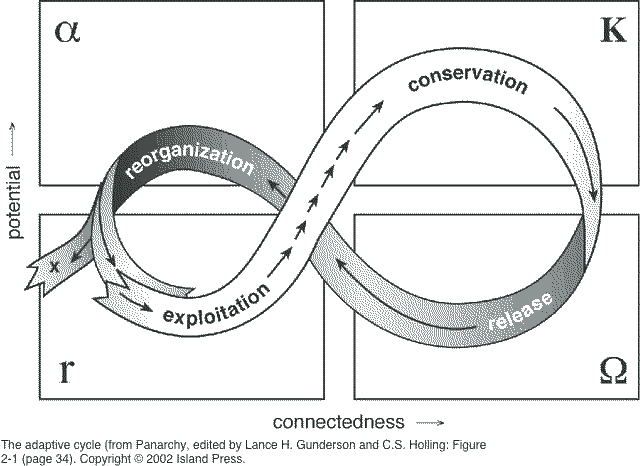
as a trend that any living system follows. So while we clearly live in the K area, lately it feels that there isn’t much potential left and things are degrading, or simply not growing.
In that reductionist reading of the cycle, the choice we have is to persist on conservation by falling into the “rigidity trap”, or trigger a release by war or degrowth.
Subsequent reads helped my understanding of the “nested” and “discontinuity” concept. These adaptive cycles are nested, feeding on each other. They are separated by externally imposed discontinuity in space, time or energy mechanisms.
I believe that we are reaching the limits of our industrialisation cycle, and that the new cycle falls into a different adaptive cycle. The old cycle was dominated by oil and gas. The new one will be dominated by coal, renewables and perhaps nuclear. The new cycle has a smaller energy footprint, less energy density and will be slightly less taxing for the earth.
It will be accompanied by more adverse conditions because of resource limits and climate impacts. We will have to rely further on the traditional adaptive cycle (e.g.: harvests without a lot of fertiliser).
Reconfiguration
Assuming we can’t sustain the amount of energy per person we currently spend and that our system will crumble no matter how much we optimise so we don’t fall into the “rigidity trap”, we will experience a humankind scale Omega phase. Perhaps we are already in it.
In this analysis, culture wars and polarisation are a consequence of this mechanism. There is uncertainty over which size will the new adaptive cycle gobern. Will it be a few superpowers? Or perhaps smaller nations?. Or even nations will be unable to exert control and the power will reside at province level?
There is also the smaller scale polarisation. Religion, ethnicity, social status are all disputed in a stage of release to lead to reconfiguration.
Strategies to avoid disruption
Assuming we are not heading for the rigidity trap, I have thought of 2 ideas so far:
Following Peter Turchin cliodynamics model, the most effective way to avoid disruption is to reduce the power of the elites. In a world with lower amount of energy per person, the current wealth inequality is not sustainable.
The current elites are the techno/surveillance elites and the wealthy. Rejecting their influence is an obvious way to reduce their power.
The second idea is to invest on communities with a smaller scope. It is unclear which communities and which scopes will emerge from the reconfiguration stage, but is is safe to say that investing on the global communities (mostly with capitalistic involvement) is likely to be unsustainable long term.
In both cases, echoing Turchin, the idea is to avoid violence.